Opening a coffee shop or adding an espresso bar to your business requires careful infrastructure planning, and overlooking your venue’s electrical system can bring operations to a costly halt before you ever pull your first shot.
While residential coffee gear plugs into any standard wall outlet, high-performance commercial espresso machines demand substantial, consistent power to keep their massive boilers heated and steam pressure stable during morning rushes. Plunging into a major equipment purchase without auditing your building’s current capacity risks tripped breakers, melted wiring, or a machine that simply refuses to turn on.
This technical guide breaks down the critical differences between convenience-driven 110V setups and heavy-duty 220V power configurations, detailing NEMA plug shapes, wire gauges, and safety protocols so you know exactly whether your existing building layout is ready or if it is time to call a licensed electrician.
Why Voltage Matters: How Power Defines Commercial Espresso Capacity
Voltage is not simply a plug compatibility issue. It directly influences how quickly an espresso machine heats its boiler, recovers after multiple drinks, and maintains steam pressure during service. A lower-voltage machine can be perfectly practical for an office, bakery, salon, or low-volume counter. However, a busy café usually needs the higher wattage available from a 220V/240V circuit.
In short, voltage helps determine whether a machine can comfortably serve ten drinks an hour or fifty drinks in a rush.
The Physics of Espresso: Amps, Volts, and Wattage Explained
Electrical power is measured in watts, calculated with a simple formula:
Watts = Volts × Amps
A 120V machine drawing 15 amps can use up to roughly 1,800 watts. A 240V machine on a 20-amp circuit can provide up to 4,800 watts. That additional capacity lets manufacturers fit larger heating elements and boilers into commercial machines.
Watts are what heat water. More available wattage generally means faster warm-up times, stronger recovery, and more consistent performance when brewing espresso and steaming milk at the same time.
Recovery Time and Steam Pressure: The Performance Gap
Every espresso shot introduces cool water into the boiler or heat-exchange system. Steaming milk also draws significant energy from the machine. If the heating element cannot replace that energy quickly, brew temperature and steam pressure can fall.
A 110V model may perform well when drinks are spaced out. But during a breakfast rush, repeated shots and several milk drinks can exceed its heating capacity. A 220V machine has more electrical headroom, allowing it to recover faster and maintain stable pressure between orders.
Why High-Volume Boilers Demand More Than Household Power
Large commercial boilers hold more water, but they also require more energy to heat. A one-group café machine may use a 4- to 6-liter boiler, while multi-group machines can use considerably more. Heating these boilers with standard household power can be slow and restrictive.
That is why most true commercial machines, particularly two-group models and machines intended for continuous milk steaming, require 208V, 220V, or 240V service. Always confirm the exact voltage listed on the machine’s data plate and installation manual.
Decoding the Power Requirements: 110V/120V vs. 220V/240V
In everyday conversation, “110V” generally means North American 120V power, while “220V” usually refers to 208V, 220V, or 240V service. Actual voltage depends on the building’s electrical system.
Commercial buildings may have 120/208V three-phase service rather than residential-style 120/240V split-phase service. Some espresso machines are designed specifically for 208V, others for 240V, and some can operate across a voltage range. This distinction matters: installing the wrong version can reduce heating performance or damage equipment.
110V/120V Outlets: Convenience vs. Performance Limits
A 110V/120V espresso machine is easier to install because it may use a common 15A or 20A receptacle. These machines are useful where electrical upgrades are impractical, including small offices, low-volume restaurants, mobile setups, and self-serve beverage stations.
The trade-off is limited wattage. A standard 15A circuit has limited capacity, and the machine should not share that circuit with grinders, microwaves, refrigerators, or other high-draw appliances. Even a compact 120V espresso machine deserves a dedicated circuit in a commercial setting.
220V/240V Outlets: Heavy-Duty Power for Continuous Service
A 220V/240V machine is the usual choice for a serious café bar. Higher voltage supplies more usable power without requiring extremely high amperage, which supports larger boilers and higher-output heating elements.
Many one-group commercial machines require a 20A or 30A 208V/240V circuit, while larger two- and three-group models may need even more capacity or hardwired installation. These machines are built to brew and steam continuously, but their electrical requirements must be planned before delivery day.
Dedicated Circuits: Why Commercial Espresso Machines Cannot Share Power
A dedicated circuit serves one appliance only. This prevents other equipment from consuming power on the same circuit and causing overloads. Espresso machines cycle their heating elements on and off, often drawing substantial current during warm-up and recovery.
Sharing a circuit with a grinder or refrigerator may seem harmless until the compressor starts while the boiler is heating. The result can be nuisance breaker trips, voltage instability, damaged wiring, or interrupted service. Follow the manufacturer’s circuit requirement exactly.
Outlets, Plugs, and Infrastructure: Identifying Your Existing Building Layout
Before buying a machine, inspect the electrical panel, nearby receptacles, breaker labels, and available circuit capacity. Do not assume a large-looking outlet is suitable or that an unused outlet is on a dedicated circuit.
A licensed electrician can identify whether your building has 120/240V or 120/208V service, determine available panel capacity, and verify whether the existing wiring and breaker match the proposed machine.
Standard Household Receptacles vs. Commercial Outlets
Most household-style outlets are 120V, 15A receptacles. They are common but not automatically appropriate for commercial espresso equipment. Commercial outlets may be rated for 20A or higher, use different slot patterns, and be installed on dedicated circuits.
Some larger espresso machines are hardwired rather than plugged in. Never use an adapter to force a plug into an incompatible receptacle. Plug configuration is a safety feature, not an inconvenience to bypass.
Understanding NEMA Ratings (NEMA 5-15 vs. NEMA 6-20 and 6-30)
NEMA ratings identify plug and receptacle configurations. A NEMA 5-15 is the familiar grounded 120V, 15A outlet. A NEMA 6-20 is commonly used for 240V, 20A equipment, while a NEMA 6-30 supports 240V, 30A loads.
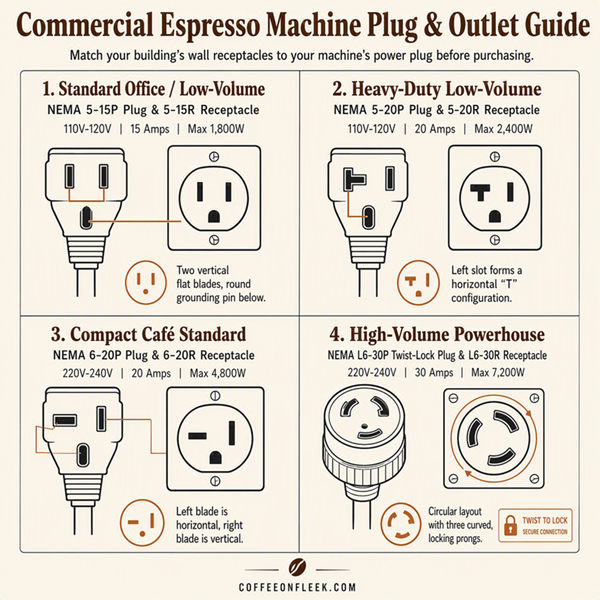
However, the correct NEMA configuration depends on the machine’s voltage, amperage, and manufacturer specifications. Some equipment may use a different plug or require hardwiring, so treat the nameplate and installation guide as the final authority.
Visual Indicators That Your Building Needs an Electrical Upgrade
Warning signs include a full electrical panel, frequently tripping breakers, extension cords behind the counter, discolored outlets, warm receptacles, or circuit labels that are missing or unclear. Older buildings may also have insufficient panel capacity for modern foodservice equipment.
If the only available outlet is shared with refrigeration, lighting, or countertop appliances, plan for an upgrade before installing the espresso machine.
Safe Sizing: Wire Gauge and Amperage Requirements
Wire size must match the circuit breaker and expected load. Undersized wire can overheat before a breaker trips, creating a serious fire risk. Circuit design must also account for local code, installation method, wire-run length, and the manufacturer’s stated electrical load.
Do not select wire size based only on online charts. A qualified electrician should size the circuit and overcurrent protection correctly.
14 AWG vs. 12 AWG: Wiring Safely for 110V Low-Volume Machines
In typical North American installations, 14 AWG copper wire is used with a 15A circuit, while 12 AWG copper wire supports a 20A circuit. A low-volume 120V machine may operate on one of these circuits, depending on its rated amperage.
A 15A plug does not automatically mean the machine should be placed on an old shared 15A circuit. For commercial reliability, a dedicated 20A circuit is often the more practical option when permitted by the equipment specifications and local code.
Why 220V/30A High-Volume Boilers Require Heavy-Duty 10 AWG Copper Wiring
A 240V, 30A espresso machine typically requires 10 AWG copper wiring and a properly matched 30A breaker. This heavy-duty setup is common for machines with larger boilers or high-output heating elements.
The exact requirements may differ for 208V equipment, hardwired machines, or units with manufacturer-specific installation instructions. Never increase a breaker size to stop nuisance trips; the wiring and appliance must be rated for that breaker.
Voltage Drop: How Long Wire Runs Impact Espresso Machine Performance
Voltage drop occurs when electricity travels through a long wire run and loses voltage along the way. Excessive voltage drop can reduce heating-element output, extend warm-up time, and impair recovery during busy service.
This is especially relevant in large retail spaces, kiosks, and buildings where the electrical panel is far from the coffee bar. An electrician may recommend larger conductors for long runs to maintain proper operating voltage.
Matching Your Business Needs to Machine Electrical Specifications
Choose machine voltage based on realistic drink volume, menu mix, available utility service, and growth plans. A 120V machine can be an excellent fit for light-duty service, but it should not be expected to perform like a high-output café machine.
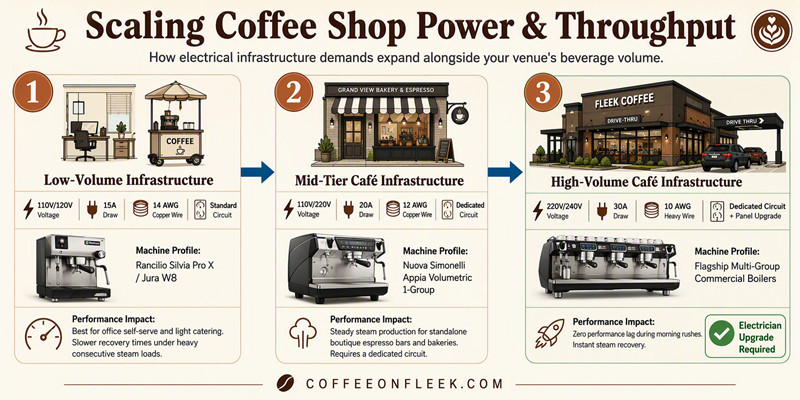
Plan electrical infrastructure around your busiest expected hour, not your slowest day.
Low-Volume Power Needs: Assessing the Rancilio Silvia Pro X (110V)
The Rancilio Silvia Pro X is a prosumer-level dual-boiler machine commonly available in a 120V configuration. It can suit low-volume environments where drink demand is limited and baristas do not need continuous commercial recovery.
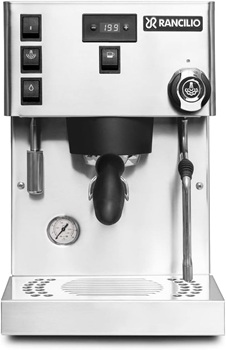
It still requires a properly grounded, dedicated circuit. Confirm the current model’s wattage, plug type, and manufacturer requirements before installation, as specifications can vary by market and revision.
Office and Self-Serve Efficiency: The Jura W8 Requirements (110V)
The Jura W8 is designed for office and self-service use, typically operating on standard 120V power in North America. Its superautomatic design makes it practical for locations that need convenience and moderate output without installing a 240V circuit.
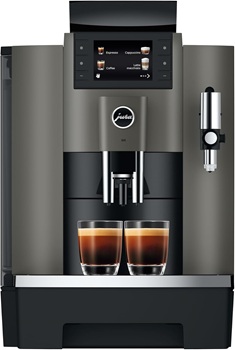
Even so, avoid sharing its outlet with other heating appliances. A dedicated 120V circuit improves reliability and helps prevent disruptions during daily use.
Small Café Standards: Powering the Nuova Simonelli Appia Volumetric 1 Group (220V)
A one-group Nuova Simonelli Appia Volumetric configured for 220V or 240V service represents a more traditional small-café setup. Its larger boiler and commercial steam capacity require higher-voltage power to support consistent service.
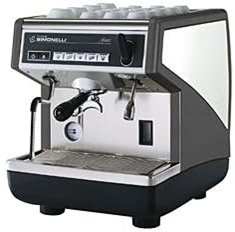
Exact electrical requirements vary by Appia version, regional configuration, and installed options. Verify whether the specific machine requires a 20A or 30A circuit or hardwiring before ordering.
Understanding how these technical specifications translate into daily throughput is crucial when shopping for gear. If you are ready to match your power capacity with the right setup for your business volume, explore our complete buying guide on the best espresso machines for commercial use to review the top picks for small cafés, offices, and mobile catering carts.
Technical Safety, Compliance, and Hiring a Professional
Espresso machine installation involves more than plugging in equipment. Water connections, drainage, filtration, grounding, shutoff access, and local health requirements can all affect the final setup.
Use qualified professionals for electrical and plumbing work, and retain installation documentation for inspections, warranty support, and future maintenance.
The Fire and Failure Risks of Overloading Existing Commercial Kitchen Circuits
Overloaded circuits can cause repeated breaker trips, overheated conductors, damaged outlets, and potentially electrical fires. Extension cords and power strips are not acceptable substitutes for a dedicated espresso-machine circuit.
Beyond safety, inadequate power can cause inconsistent temperatures, weak steam, slow recovery, and premature failure of electrical components.
When to Call a Licensed Electrician: Upgrading Panels and Running 30A Lines
Call a licensed electrician before purchase if your machine requires 208V/240V power, a 20A or 30A dedicated circuit, hardwiring, or a new outlet location. They should assess panel capacity, verify service voltage, run correctly sized conductors, and install the required breaker and receptacle.
Schedule this work early. Electrical upgrades can affect permits, inspections, construction timelines, and equipment delivery dates.
Local Electrical Codes and Commercial Foodservice Inspections
Electrical work must comply with local building codes, the National Electrical Code where applicable, and any requirements from your landlord, insurer, or health department. Commercial inspections may also evaluate equipment placement, accessibility, grounding, and safe installation practices.
The bottom line: a 120V machine can work well for modest demand, while a 220V/240V machine is usually essential for sustained café service. Match the machine to your volume, then verify your building can safely power it before making the investment.