If you are shopping for your first super-automatic espresso machine, convenience is probably one of the main reasons you are interested. These machines grind whole beans, brew espresso, and depending on the model, prepare milk drinks with the touch of a button.
But they are a significant investment, so it is natural to ask: How long do super-automatic espresso machines last?
In general, a good super-automatic espresso machine lasts about five to ten years in a typical home. With excellent maintenance, moderate use, and occasional professional servicing, some premium models can last longer. More affordable machines may still provide many years of service, but they may have simpler components, shorter warranties, or fewer repair options.
The exact lifespan depends on the machine, how often you use it, the quality of your water, the coffee beans you choose, and most importantly — how well you maintain it.
Average lifespan of a super-automatic espresso machine
A super-automatic espresso machine has more mechanical and electronic components than a standard drip coffee maker. It contains a grinder, pump, heating system, brew group, water lines, sensors, and often an automatic milk system.
Because of this, the machine may eventually need replacement parts or servicing. That does not necessarily mean it has reached the end of its useful life.
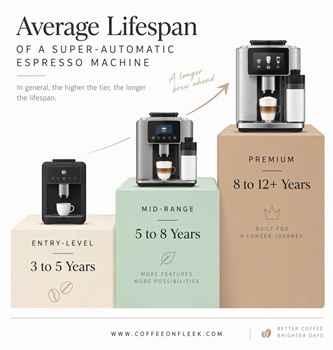
Here is a general lifespan guide:
- Entry-level machines: Approximately 3 to 5 years
- Mid-range machines: Approximately 5 to 8 years
- Premium machines: Approximately 8 to 12 years or longer
- Heavy-use machines: Lifespan varies depending on daily drink volume and maintenance
A machine used to make two or three drinks each day will usually experience less wear than one used to prepare 15 or 20 drinks daily. However, regular use itself is not harmful. Super-automatic machines are designed for everyday brewing. The bigger concern is using a machine heavily without cleaning or descaling it.
What determines how long a super-automatic machine lasts?
Daily usage
The number of drinks you prepare each day has a direct effect on wear. Every drink activates the grinder, pump, heating system, and brew group.
If you are buying a machine for one or two people who drink a few coffees per day, most quality home models should provide years of reliable service. If your household has several coffee drinkers or you regularly entertain guests, choose a machine with a higher recommended daily capacity.
Manufacturers often publish an approximate daily drink recommendation. It is worth checking this specification before buying, particularly if you plan to use the machine frequently.
Water quality
Hard water is one of the most common causes of espresso machine problems. It contains minerals that can accumulate inside the heating system and water lines. Over time, mineral buildup can reduce water flow, affect brewing temperature, and put additional strain on the machine.
Using filtered water can help reduce this buildup. Many super-automatic espresso machines also accept replaceable water filters that attach inside the water tank.
A filter does not eliminate the need for descaling. You should still run the manufacturer’s descaling program whenever the machine prompts you or according to the maintenance schedule in the manual.
If you live in an area with particularly hard water, regular testing and more frequent descaling may be necessary.
Cleaning and maintenance
Super-automatic machines perform many cleaning tasks automatically, but they are not maintenance-free. The automatic rinse cycle is only one part of keeping the machine clean.
Coffee oils and fine grounds can build up in the grinder, brew group, and coffee spout. Milk residue can collect in tubes and nozzles. If this buildup is ignored, drinks may taste stale, milk may stop frothing properly, and internal parts can become blocked.
A neglected machine can develop expensive problems much sooner than one that receives regular care.
Coffee beans
The beans you use also affect the machine. Very oily beans—often associated with some dark roasts—can leave residue inside the grinder and brewing system. Flavored beans may be coated with oils or flavoring agents that can be especially difficult to remove.
For most super-automatic machines, choose beans that are:
- Fresh but not visibly oily
- Medium or medium-dark roasted
- Free from added flavoring oils
- Suitable for use in automatic grinders
This does not mean you must avoid dark-roast coffee. Look for beans with a dry or slightly glossy appearance rather than beans that look wet or heavily coated in oil.
Build quality and repairability
The quality of the grinder, pump, heating system, seals, and internal electronics influences how long a machine may last. Premium machines often use more durable parts, but price alone does not guarantee reliability.
Repairability is just as important. Before purchasing, find out whether the manufacturer provides:
- Replacement parts
- Authorized service centers
- A meaningful warranty
- Customer support after the warranty expires
- Service for the grinder, brew group, and milk system
A machine that can be repaired may remain useful for years after its warranty ends. A less expensive machine that cannot be serviced may need to be replaced after a relatively minor failure.
Which parts are most likely to wear out?
Understanding the main components can help you make a more informed purchase.
Grinder
The grinder operates every time you brew a coffee. Its burrs can eventually become dull, especially with high daily use or oily beans. A worn grinder may produce inconsistent grounds, which can lead to weak or uneven espresso.
Brew group
The brew group compresses the ground coffee and moves it through the brewing process. Coffee residue can accumulate in this assembly, so keeping it clean is important.
Some machines have removable brew groups that can be rinsed at home. Others use sealed internal systems and rely more heavily on automatic cleaning programs or professional servicing.
Pump
The pump creates the pressure required for brewing espresso. A weakening pump may result in slow brewing, watery coffee, inconsistent pressure, or a machine that stops brewing altogether. Heating system
Thermoblocks and boilers heat the water used for brewing and steaming. Mineral deposits can reduce their performance and shorten their working life, which is why water quality and descaling matter so much.
Seals and gaskets
Rubber seals naturally become less flexible over time. Worn seals may cause leaks around the brew group, water tank, or milk system. Fortunately, seals and gaskets are often replaceable during routine servicing.
Milk system
Automatic milk systems are particularly sensitive to poor cleaning. Milk residue can block tubes and nozzles, create unpleasant odors, and affect the texture of your foam. If you regularly make lattes or cappuccinos, choose a machine whose milk system is easy to disassemble and clean.
Reliable brands to consider
Brand reputation can be helpful when choosing a first machine, but reliability varies by model. Read reviews for the specific machine you are considering and pay attention to long-term ownership experiences, not just initial impressions.
Jura
Jura is a popular premium brand known for attractive designs, consistent espresso, and sophisticated one-touch drink systems. Its machines often provide a polished user experience and convenient automatic cleaning programs.
Many Jura models use internal brew groups that are not designed for routine removal by the owner. This can make professional servicing more important over the long term. Following the cleaning instructions, using the recommended cleaning products, and replacing water filters as directed are essential.
Jura is a strong option for buyers who want premium convenience and are comfortable paying more for the machine and potential servicing.
De’Longhi
De’Longhi offers one of the broadest ranges of super-automatic espresso machines. Its lineup includes affordable entry-level models as well as machines with advanced milk systems and extensive drink customization.
Many De’Longhi machines are popular with first-time buyers because they are widely available, relatively easy to operate, and offered at several price points. Depending on the model, the brew group may be removable for regular home rinsing and maintenance.
When comparing De’Longhi machines, look closely at the grinder settings, milk system, cleaning process, and recommended daily capacity. Two machines from the same brand can have very different ownership experiences.
Gaggia Brera
The Gaggia Brera is a compact super-automatic espresso machine that is often considered by buyers who want a straightforward bean-to-cup experience without purchasing a large, expensive machine.
Its relatively simple design and removable brew group appeal to owners who prefer hands-on maintenance. The Gaggia Brera can prepare espresso and coffee drinks conveniently, while its steam wand gives users more control over milk frothing than a fully automatic milk carafe.
Because it has a traditional steam wand, it may require a little more involvement than some one-touch machines. However, that can also make the system easier to understand and clean. As with any espresso machine, using fresh, non-oily beans and maintaining the brew group will help support long-term performance.
The Gaggia Brera is a good option for buyers who want a compact machine, straightforward controls, and the ability to clean important components themselves.
Maintenance tips to extend the machine’s life
A few minutes of regular care can make a significant difference.
After every use
If you prepare a milk drink, wipe and purge the steam wand or clean the automatic milk nozzle immediately. Milk residue becomes more difficult to remove once it dries.
Also, pay attention to the machine’s rinse cycles. Allow the machine to complete its automatic rinse rather than switching it off or unplugging it during the process.
Every day
- Empty the coffee grounds container when prompted
- Empty and rinse the drip tray
- Rinse the milk container or milk tubing
- Wipe the coffee spout and milk nozzle
- Avoid leaving milk in the system overnight
Every week
- Rinse the brew group if your model allows removal
- Wash the water tank and drip tray
- Clean the coffee grounds container
- Brush loose grounds from the brewing area
- Check the grinder and coffee chute for buildup
Do not use soap on parts unless the manufacturer specifically recommends it. Residue from household detergents can affect flavor and damage certain components.
Monthly or as directed
- Run the manufacturer’s cleaning tablet program
- Clean the milk system thoroughly
- Lubricate the brew group if the manual recommends it
- Replace the water filter according to the schedule
- Inspect the machine for leaks or unusual noises
Descale when required
Descaling removes mineral deposits from the internal water system. Follow the instructions for your specific machine and use the recommended descaling solution.
Avoid homemade descaling mixtures unless the manufacturer explicitly approves them. Some household acids may damage seals or internal parts, and using an unapproved product could affect warranty coverage.
Warning signs that your machine needs service
Some problems can be solved by cleaning the machine or adjusting the grinder. Others require professional attention.
Arrange service if you notice:
- Water leaking from inside or underneath the machine
- Repeated error messages
- A grinder that suddenly becomes unusually loud
- Espresso that remains weak after adjusting grind and dose
- A brew group that sticks or will not return to position
- Milk that will not froth after the system has been cleaned
- Unusual electrical smells, smoke, or overheating
- A significant change in brewing time or water flow
If the machine shows signs of electrical damage, stop using it and contact the manufacturer or an authorized technician.
Is a super-automatic espresso machine a good long-term purchase?
For many households, a super-automatic espresso machine is worth the investment. It can produce consistent coffee quickly and reduce the effort involved in grinding, tamping, brewing, and cleaning.
The trade-off is that convenience comes with additional mechanical and electronic parts. These machines require more maintenance than a simple drip coffee maker, and some repairs can be costly after the warranty expires.
When comparing machines, look beyond the number of available drink recipes. Consider:
- The manufacturer’s warranty
- Recommended daily drink capacity
- Water-filter and cleaning-product costs
- Whether the brew group is removable
- How easy the milk system is to clean
- Availability of replacement parts
- Local repair and service options
The bottom line
Most super-automatic espresso machines last five to ten years, while well-maintained premium models may last longer. Jura, De’Longhi, and Gaggia, including the compact Gaggia Brera, are all brands worth researching for a first purchase.
The best way to extend your machine’s lifespan is to use suitable coffee beans, protect it from hard-water buildup, complete cleaning cycles promptly, and perform the hands-on maintenance recommended by the manufacturer.
Choose a machine that fits your coffee habits and that you will be comfortable maintaining. With the right care, your first super-automatic espresso machine can provide years of convenient, café-style coffee at home.