A commercial espresso machine is not simply another appliance behind the counter. It is revenue infrastructure. When it is clean, heated correctly, and supplied with properly treated water, it produces consistent drinks, supports fast ticket times, and helps staff work confidently during busy periods. When it is neglected, the same machine can create sour or bitter shots, weak steam pressure, leaks, slow recovery, customer complaints, and costly service calls.
A successful installation is only the starting point. Whether you operate a traditional volumetric machine such as the Nuova Simonelli Appia, a low-volume prosumer machine, or a super-automatic office unit, its lifespan depends on a repeatable preventative-maintenance routine.
This commercial espresso machine maintenance checklist divides essential tasks into daily, weekly, and monthly intervals. Always confirm your machine manufacturer’s instructions before using cleaning chemicals, removing components, or changing water-treatment settings. Those instructions take priority, particularly for warranty-covered equipment.
If you are still selecting equipment, see our guide best espresso machines for commercial use for small businesses. The right machine matters but strict cleaning habits are what protect that investment over years of service.
Why Preventative Maintenance Matters for Small Businesses
Mitigating the financial impact of machine downtime
For a café, bakery, catering operation, or office coffee program, an espresso machine failure is rarely a minor inconvenience. It can stop a key part of the menu, slow the entire counter, force employees into workarounds, and send regular customers elsewhere.
Preventative cleaning reduces the common causes of avoidable downtime:
- Clogged shower screens and group passages
- Leaking or hardened group gaskets
- Blocked drain lines and overflowing drip trays
- Steam-tip milk residue that restricts airflow
- Grinder clogs and inconsistent dosing
- Scale accumulation in boilers, solenoids, valves, and heat exchangers
A five- to 15-minute task completed at the correct interval is far less expensive than an emergency technician visit during a Saturday rush. It also helps protect warranty coverage. Many manufacturers and service providers will ask about water filtration, cleaning records, and maintenance practices before approving a repair claim.
The chemistry of coffee: how oil buildup ruins espresso flavor
Coffee contains oils and fine particles that stick to hot metal surfaces. Each shot leaves a small amount of residue on the shower screen, dispersion plate, basket, portafilter spouts, and group head. Milk proteins also bake onto steam wands when the wand is not wiped and purged immediately.
Fresh coffee oils contribute aroma and body in the cup. Old coffee oils become rancid. Once they accumulate, they can make even a well-dialed espresso taste harsh, bitter, smoky, or stale. Baristas may try to compensate by changing the grind, dose, or yield, but the true cause can be a dirty group or basket.
Cleaning is therefore part of espresso quality control, not just a closing chore.
Combatting scale: the number one killer of commercial boilers
Scale is mineral buildup, primarily calcium and magnesium, left behind when hard water is heated. It insulates heating elements, restricts water pathways, affects temperature stability, reduces boiler efficiency, and can damage expensive internal components.
A machine can look spotless from the outside while scale quietly develops inside its boiler and hydraulic system. Signs may include slower thermal recovery, lower steam output, erratic pressure, reduced flow, or repeated valve issues.
The first defense is not descaling powder; it is properly matched water treatment from day one. Review our guide to the best water filtration and softening systems for commercial espresso machines to choose a system appropriate for your local water chemistry and expected drink volume. Test water regularly, replace cartridges on schedule, and never assume a filter is still effective just because water is flowing through it.
The Daily Commercial Espresso Machine Cleaning Schedule
Daily cleaning should be built into both service workflow and closing procedures. Divide responsibilities clearly: baristas handle operational upkeep, while the closing employee or manager verifies that the end-of-day tasks are completed and logged.
Mid-shift operational upkeep: every two to four hours
During service, small cleaning actions prevent residue from becoming a larger problem later.
Purge and wipe steam wands after every use
Immediately after steaming milk:
- Turn off the steam valve.
- Wipe the wand with a clean, damp bar towel reserved for steam-wand use.
- Briefly open the steam valve again for one to two seconds to purge milk from the tip.
Do not wait until the next drink. Milk can be drawn into the steam tip as pressure drops, then bake inside the openings. A blocked steam tip produces weak, uneven steam and makes proper milk texture difficult.
Use a separate cloth for the steam wand, not the cloth used for wiping counters, portafilters, or hands. Replace cloths as needed throughout the day. If milk has dried on the wand, use an approved milk-system cleaner and a non-abrasive pad; do not scrape the wand with a knife, pin, or harsh metal tool.
Flush group heads between shot cycles
After removing a portafilter, run water through the group head for one to three seconds. This rinses loose grounds from the shower screen and reduces the chance of old coffee entering the next extraction.
For a busy café, also perform a slightly longer flush whenever a group has been idle for several minutes. This helps clear overheated water from the group and refreshes the brewing surface before the next shot. Avoid excessive flushing that disrupts workflow or wastes water, but do not leave coffee residue sitting on a hot screen all day.
Knock box management and basket wiping
Knock out the puck promptly after each shot. Wipe the basket dry with a clean bar towel before dosing again. A dry, clean basket supports even distribution and limits old grounds from contaminating the next dose.
Empty the knock box before it becomes overfilled. Wet, decomposing pucks can grow mold, attract pests, and make the work area unsanitary. Clean the knock box at closing with hot water and detergent, then let it air-dry.
End-of-day closing breakdown: the nightly routine
The closing routine is the most important part of daily espresso machine care. Schedule enough labor time to do it properly rather than asking employees to rush it after the shop is closed.
Chemical backflushing step by step using cleaning powder
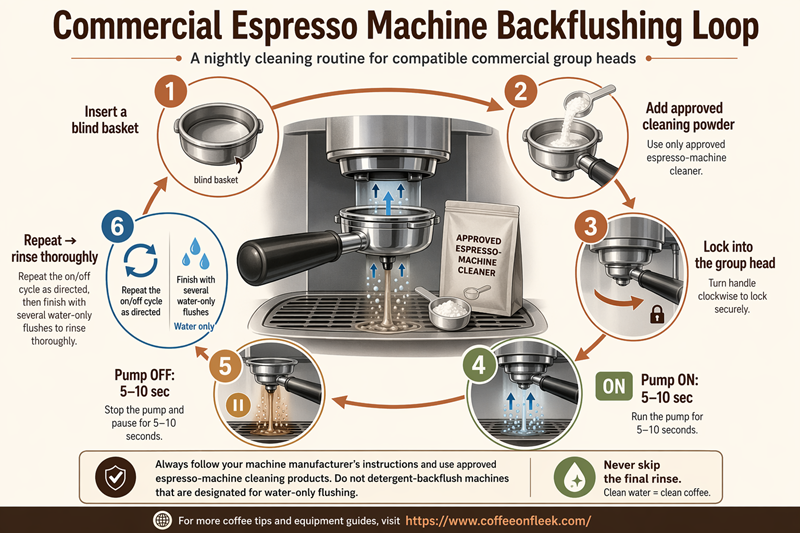
Traditional commercial machines with three-way solenoid valves generally require detergent backflushing. However, use only the manufacturer-approved espresso-machine cleaner and follow the machine-specific instructions for dose, cycle length, and frequency. Do not detergent-backflush a machine that the manufacturer says should be water-flushed only.
For a typical commercial group head:
- Remove the regular basket from the portafilter and insert a blind basket, also called a backflush basket.
- Add the recommended amount of approved espresso-machine cleaning powder or tablet. More chemical is not better.
- Lock the portafilter into the group head.
- Run the pump for the manufacturer-recommended interval, often around five to 10 seconds, then stop it for a similar interval. This sends cleaner through the group, solenoid valve, and exhaust pathway.
- Repeat the on/off cycle several times as directed.
- Remove the portafilter carefully and rinse the blind basket.
- Run several water-only backflush cycles until no detergent residue or foam remains.
- Reinstall the regular basket and pull a brief water flush through the group.
Repeat for every group head. If your machine has programmable cleaning cycles, use the approved automated cycle but still inspect the groups afterward.
Chemical residue can ruin drinks and may irritate customers or staff. Always rinse thoroughly. Record the cleaning completion in the closing log.
Soak portafilters and baskets in cleaning solution
Remove baskets from portafilters and soak the baskets, spouts, and metal portions of portafilters in a solution of approved espresso cleaner and warm water. Follow the cleaner’s dilution and contact-time instructions.
Keep plastic, wood, rubber, and handle components out of the solution whenever possible. Extended soaking can discolor finishes, weaken lubricants, or damage handles. After soaking, scrub remaining residue with a nylon brush, rinse fully with clean water, and dry before reassembly.
Check basket holes while cleaning. If holes are blocked or distorted, replace the basket rather than aggressively poking it with sharp objects.
Deep-clean steam wands and disassemble nozzles
At closing, inspect each steam tip closely. Remove it only if the manufacturer permits easy removal and staff have been trained to do so. Soak the removable tip in approved milk-system cleaner, rinse it thoroughly, and reinstall it securely.
Never soak electrical controls, the entire steam wand assembly, or any part that should remain attached according to the manual. If the tip is badly blocked, steam pressure is weak, or the wand leaks at its valve, note the problem for a manager or technician.
Wipe the full length of the wand, including the area near the pivot joint. Milk residue in this area can be missed during service but is still a sanitation and performance concern.
Scrub group gaskets and shower screens with a dedicated brush
Use a group-head brush to scrub around the gasket, shower screen, and underside of each group. This removes loose grounds that detergent backflushing may not dislodge.
Inspect the gasket while brushing. It should look supple and form a reliable seal around the portafilter. A cracked, flattened, or brittle gasket will eventually cause water to spray or leak around the portafilter during extraction.
Flush the drip tray with hot water to clear sludge
Remove and wash the drip tray, grate, and drain box if applicable. Flush the drain area with hot water to move coffee grounds, milk residue, and syrup spills through the line.
Do not pour large quantities of loose espresso grounds into the drain. They combine with coffee oils and can create dense sludge. If the drain is slow, smells sour, or backs up, address it early rather than repeatedly rinsing over the problem.
The Weekly Maintenance Ritual: Deep Cleansing and Inspection
Weekly maintenance goes beyond the visible surfaces cleaned at closing. Plan it during a quiet period when the machine can be taken out of service briefly.
Execute a chemical-free water backflush checklist
Water-only backflushing is useful for checking how cleanly each group is exhausting and whether the solenoid path appears to be flowing normally. With a clean blind basket installed, run several short water-only cycles on each group.
Observe the discharge into the drip tray. It should release consistently when the pump stops. Unusual delays, weak discharge, or persistent debris may indicate a dirty valve pathway or a developing mechanical issue.
This does not replace detergent backflushing where detergent is specified. Think of it as a supplementary inspection and rinse step.
Disassemble and soak group head components
Remove shower screens and diffuser screws
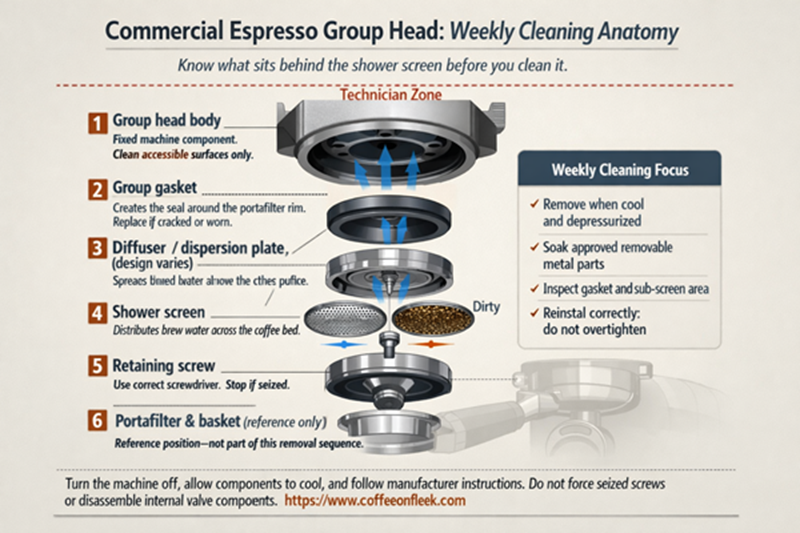
With the machine cool enough to work safely and the group depressurized, remove the shower screen and diffuser screw using the correct screwdriver. Keep screws and components organized by group head.
Soak removable metal shower screens and diffuser parts in approved espresso cleaner. Do not force stripped screws or pry on components with sharp tools. If a screw is seized, stop and arrange service rather than damaging the group head.
Inspect for sub-screen coffee residue accumulation
Behind the shower screen, inspect for compacted coffee residue, dark oil film, or uneven buildup. Clean the area gently with a group brush and a clean cloth. Rinse and reinstall components correctly.
Sub-screen buildup can interfere with even water dispersion. That may show up as channeling, inconsistent flow, or shots that suddenly run too fast or too slow despite stable grinder settings.
Sanitize the drain tray line and hose infrastructure
Clean the drip tray and drain box thoroughly, then flush the drain line according to local plumbing rules and the equipment manufacturer’s guidance. Use a food-safe drain maintenance product only if it is compatible with your plumbing and machine setup. Avoid caustic chemicals that could harm hoses, fittings, or seals.
Inspect for leaks beneath the counter, unusual odors, slow drainage, or standing water. The drain line should maintain the proper downward slope established during installation. For a refresher on drain routing, air gaps, filtration, regulators, and related setup details, see our commercial espresso machine installation guide: plumbing, power, and filtration.
Integrate grinder maintenance for shot consistency
The espresso machine cannot produce consistent coffee if the grinder is coated in old oils or retaining stale grounds. Empty the hopper as appropriate, brush accessible grounds from the chute, wipe the hopper, and use manufacturer-approved grinder-cleaning pellets if recommended.
Do not put water into burrs or grind chamber components. Check the burr chamber for excessive oily buildup, clumping, or retained coffee. These problems can alter dose weight and flow rate even when the grind setting has not changed.
The Monthly Preventative Checklist: Hardware and Water Checks
Monthly checks help identify small wear items before they become service interruptions. Keep notes so you can compare changes over time.
Inspect and replace wear-and-tear consumables
Evaluate group gasket elasticity
Lock a clean portafilter into each group and note whether it seals at the usual position. If it must be turned unusually far to seal, leaks around the rim, feels excessively loose, or shows cracking, the group gasket may need replacement.
Gaskets are inexpensive consumables, but replacement can be difficult on some machines. Train a qualified employee only if your manufacturer permits it and your team has the correct tools. Otherwise, bundle gasket replacement with scheduled professional service.
Assess shower screen wear and basket tension springs
Inspect shower screens for warping, damage, blocked holes, or a surface that no longer cleans well. Replace worn screens rather than trying to restore heavily damaged parts.
Also inspect portafilter baskets and basket-retention springs. A basket that falls out too easily, fits loosely, or has bent edges can affect workflow and create a burn hazard when knocking out hot pucks. Replace worn springs and baskets promptly.
Test water hardness and softening-system performance
Test the incoming water and, where possible, the treated water using the test method recommended by your filtration provider. Record hardness, cartridge date, and total water usage if your system has a meter.
Replace filter or softening cartridges based on measured capacity, water hardness, and actual volume—not just a calendar estimate. A high-volume shop can exhaust a cartridge much sooner than a low-volume bakery or office. Conversely, an underused system may have sanitation or stagnant-water concerns that also require attention.
Monitor boiler pressure and thermal recovery cycles
Watch the pressure gauge and observe whether the machine returns to operating temperature and pressure normally after several drinks. A slow recovery time, weak steam, unstable brew temperature, or unexpected pressure changes can point to scale, heating-element issues, pressure-stat or sensor faults, or water-supply problems.
Do not open a pressurized boiler or attempt a chemical boiler descale without manufacturer approval and proper training. On many commercial machines, professional descaling is safer than an in-place chemical treatment because loosened scale can block valves and passages.
Tailoring Your Schedule by Machine Type and Venue Volume
Workflow differences for volumetric vs. semi-automatic systems
Volumetric machines automate water volume, but they do not automate cleanliness. They still require purging, detergent backflushing where approved, gasket inspection, and regular shower-screen cleaning. Semi-automatic machines add more manual brew control, which makes barista training and consistent cleaning especially important.
Higher-volume cafés should increase the frequency of mid-shift wiping, flushing, knock-box emptying, and grinder checks.
Maintenance realities for super-automatic office machines
Super-automatic machines reduce manual brewing steps, but their automated rinse and cleaning programs are not optional. Staff should empty drip trays and puck bins, refill milk or water systems as required, run prompted cleaning cycles, and use only the approved tablets, milk cleaner, and filters.
In self-serve settings, assign one accountable person rather than assuming every user will complete maintenance. Milk systems need particular attention because residues can become a food-safety issue quickly. See our guide to the best super-automatic espresso machines for offices and breakrooms for models and maintenance considerations suited to shared environments.
Mobile operations: carts and food trucks
Food trucks and carts often use external tanks, compact drains, vibration-prone plumbing, and 110V power limitations. Check tank cleanliness, water levels, hose connections, drain containers, and power-cord condition daily. Empty wastewater tanks responsibly and never allow wastewater to sit until it smells or backs up.
Because mobile units may be moved frequently, inspect fittings for vibration-related leaks and confirm that water treatment remains appropriate for the water source being used.
Creating Accountability: Implementing a Coffee Shop Cleaning Schedule
Create visual checklists and staff logging protocols
A checklist only works when it is visible, specific, and assigned. Post a laminated daily closing list near the machine, keep weekly and monthly tasks in a manager binder or digital log, and include:
- Task name and machine/group number
- Required cleaner or tool
- Completion time and employee initials
- Notes on leaks, unusual noises, pressure changes, or replacement needs
- Filter-test results and cartridge replacement dates
Managers should review logs rather than simply assuming tasks were completed.
Know when to call a certified commercial espresso technician
Call for service when you see repeated leaks, electrical issues, burning smells, severe pressure instability, slow filling, poor thermal recovery, persistent drain backups, steam-valve problems, or unexplained changes in shot performance after normal cleaning and grinder checks.
Budget for annual professional service and boiler descaling
Set aside money for annual or more frequent, in high-volume operations, professional inspection. A technician can inspect internal fittings, safety valves, pumps, heating systems, seals, and scale conditions that staff cannot safely access. Water quality and usage volume should determine whether descaling is necessary.
Consistency Breeds Business Success
A clean, well-maintained commercial espresso machine delivers more than a longer service life. It supports reliable shot quality, stronger steam performance, quicker ticket times, cleaner workstations, and happier customers.
Make daily cleaning non-negotiable, use weekly checks to catch hidden residue and drainage issues, and use monthly inspections to monitor water treatment and wear parts. With documented accountability and timely professional service, preventative maintenance becomes a practical way to protect both your equipment and your revenue.
If you are still designing your coffee station or comparing equipment, return to our guide to the best espresso machines for commercial use for small businesses and our commercial espresso machine installation guide to build a setup that is easier to maintain from the start.